Today is Saint Mary’s day, the Festa dell’Immacolata, or the Feast of the Immaculate Conception. Celebrated on December 8th, this feast day holds deep religious significance for Catholics around the world. In Sicily there are some lovely local traditions which predictably involve public celebrations, mass that lasts extra long, and cake.
Since it is also the onomastic or “name day” of everyone called Maria, I’d like to begin by wishing blessings and good fortune to anyone called Mary, Maria or any variation of that. This is your special day so I hope you get treated as extra special – because you are!
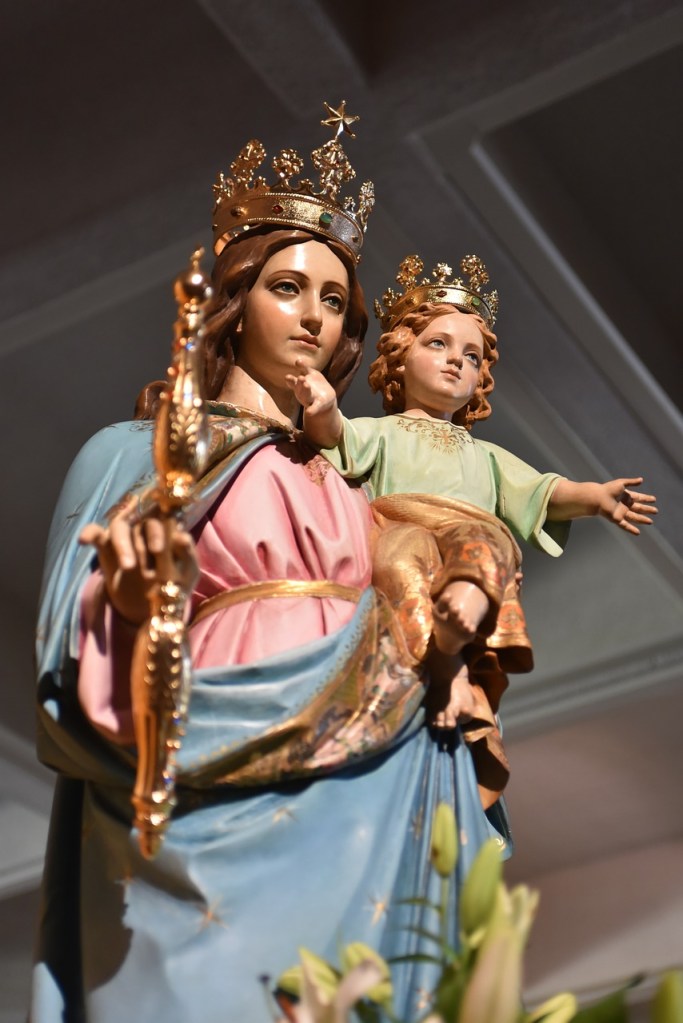
What is the Festa dell’Immacolata?
The Festa dell’Immacolata honors the belief in the Immaculate Conception of the Virgin Mary — the doctrine that Mary, from the moment of her conception, was free from original sin. It is one of the most important feast days in the Catholic Church, commemorating Mary as a model of purity and grace.
In Sicily back in the old days, some people decided to go the whole hog and not just name their daughter Maria but actually called baby girls Immacolata, which means Immaculate, and Concezione, which means Conception. Whilst not being quite as comedic as calling a girl Crocifissa, which means crucifix, I’d say it’s possibly as far-fetched as calling a girl Vergine which, you guessed it, means Virgin.
Anyway, moving swiftly on…
The Significance of the Feast of the Immaculate Virgin in Sicily
In Sicily, the Immacolata is a symbol of devotion, hope, and renewal. The the Feast of the Immaculate Conception brings together locals in every town and village of Sicily to honour her and, equally importantly, see each other to catch up on gossip and show off their new clothes. Call me sceptical, but this is actually 50% of why Sicilians love going to church every Sunday.
Many Sicilian cities and towns, especially those with historical ties to the Church, take this occasion to celebrate with public processions, masses, and elaborate celebrations.
The Religious Celebrations
Early on the morning of December 8th, Sicilians gather in churches for solemn masses dedicated to the Virgin Mary. In some areas, the day begins with special vigils and prayers, as well as the lighting of candles, which symbolise the light of the Virgin Mary spreading through the world.
The highlight of the religious celebrations in many towns is the procession of the Virgin Mary. This tends to happen in places where the church happens to be dedicated to Mary, and her statue is paraded through the streets, carried by devotees who accompany it with prayers and traditional songs. These processions are always great fun, the perfect blend of sincere religious devotion and family and community celebtration and fun at the same time. The streets tend to be packed but the crowds move together in unity and the music is always emotional, especially when it involves those fabulous Sicilian drummers.
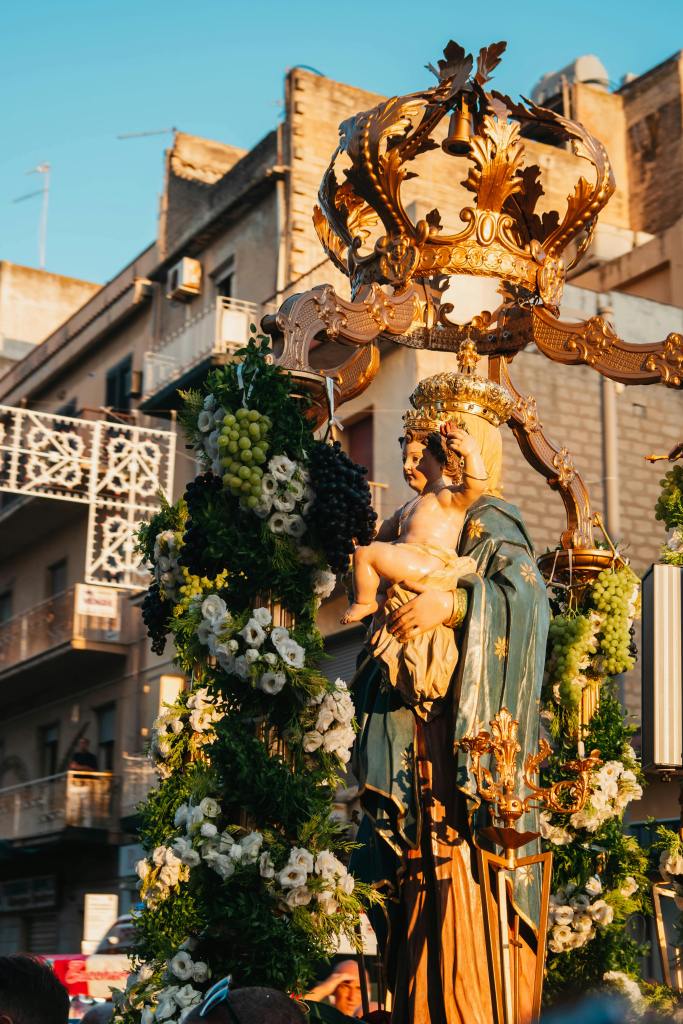
In cities like Catania, Palermo, and Agrigento, where devotion to the Virgin Mary is especially strong, the celebrations take on a particularly grand scale. Statues of the Immaculate Conception are carried through the streets in impressive processions, while local parishes host events and gatherings for both the faithful and visitors.
In Catania, for example, the celebrations extend throughout the entire week leading up to the 8th. There are religious events at the Cathedral of Saint Agatha, processions through the city, and various community events in the neighbourhoods. Palermo, too, hosts a grand procession that winds through the streets of the city, ending at one of the local churches dedicated to the Virgin Mary.
The Foods for the Virgin Mary
While the religious rituals are at the forefront of the celebration, the Festa dell’Immacolata in Sicily is also a time for traditional foods. Of course. Families often come together to prepare massive Sicilian meals, with an emphasis on dishes that reflect the region’s culinary history. It’s a very enjoyable warm-up to Christmas.
In the days leading up to the 8th, Sicilian towns and cities host lively outdoor markets where locals sell festive treats and religious items. If you’re on holiday in Sicily in December (a great idea since the weather is usually lovely) you can look out for everything from hand-painted religious icons to marzipan sweets, nuts, and dried fruits.
Buccellato tends to be popular for this festival. It’s really a nice nibble for the whole Christmas season, Sicily’s answer to mince pies. The sweet and slightly tangy filling contrasts with the soft, buttery dough of the crust. Buccellato is flavoured with citrus zest (particularly lemon) and a slosh of Marsala wine or sweet liquer.
The outer crust is usually soft, sweet, and lightly golden-brown and it’s a round or ring-shaped Sicilian pastry. On top, being SIcilians, they put white icing and multicoloured sprinkles which English people call “hundreds and thousands”. The inside has a combination of dried figs and sometimes other dried fruit, nuts – especially walnuts or almonds – and sometimes marzipan.
A Blend of Faith, Family, and Tradition
The Festa dell’Immacolata is more than just a religious event in Sicily. It is a time to celebrate the deep faith that binds its people together, unify families and communities, and eat really, really massive amounts of food.
Have a lovely Festa dell’Immacolata, everyone!
Discover more from The Dangerously Truthful Diary of a Sicilian Housewife
Subscribe to get the latest posts sent to your email.
 The Dangerously Truthful Diary of a Sicilian Housewife
Molto bene. Mille grazie !!
LikeLike
Grazie mille! Always interesting.
LikeLike
A delightful commentary on The ‘Festa dell’Immacolata’ infused with the comedy element that we expect (and love) from the ‘Dangerously Truthful Sicilian Housewife’..let’s hope she’s not armed xxx
LikeLiked by 1 person